
The Last Hour at the WACA: Konstas's 151*, NSW's Declaration, and Hardie's 12-Day Stand-Down
**मुख्य उत्तर:** सैम कोन्स्टास ने शेफील्ड शील्ड मुक़ाबले में पहली पारी में 71 और दूसरी पारी में नाबाद 151 रन बनाए। न्यू साउथ वेल्स ने 262/5 पर पारी घोषित कर पश्चिमी ऑस्ट्रेलिया को 364 का लक्ष्य दिया, और तीसरे दिन स्टंप्स तक मेज़बान टीम 30/3 पर सिमट गई। एरॉन हार्डी कंधे की चोट पर मेडिकल सब्स्टीट्यूशन से बाहर हुए, जिससे 12 दिन की अनिवार्य पाबंदी लगी। **मुख्य तथ्य:** - सैम कोन्स्टास का 151* 167 गेंदों पर आया, चार छक्कों के साथ, स्ट्राइक रेट लगभग 90। - यह कोन्स्टास का पाँचवाँ फर्स्ट-क्लास शतक था, जो 136 गेंदों पर पूरा हुआ। - न्यू साउथ वेल्स ने पहली पारी में 440 और दूसरी में 262/5d बनाए; पश्चिमी ऑस्ट्रेलिया पहली पारी में 339 पर सिमटी। - बेन ड्वार्शुइस ने 2-5 और जैक एडवर्ड्स ने 1-0 के आँकड़े स्टंप्स से पहले की पाँच गेंदों में दर्ज किए। - एरॉन हार्डी के स्थान पर अनकैप्ड कॉरी वॉज़ली मैदान में आए; हार्डी के खाते में 15 वनडे और 18 टी20 अंतरराष्ट्रीय हैं। **स्रोत:** शेफील्ड शील्ड मैच रिपोर्ट एवं सार्वजनिक स्कोरकार्ड आधारित विश्लेषण (स्रोत सामग्री में प्रकाशन तिथि उल्लिखित नहीं) | Cross-checked: cricsultan.com **संबंधित प्रश्न-उत्तर:** प्रश्न: कोन्स्टास का 151* टेस्ट चयन के लिए पर्याप्त आधार है? उत्तर: दो पारियों का यह जोड़ा मज़बूत संकेत है, लेकिन घरेलू और विदेशी परिस्थितियों का बँटवारा तथा तेज़ आक्रमण के ख़िलाफ़ आँकड़े उपलब्ध नहीं, इसलिए निष्कर्ष अभी अधूरा है। प्रश्न: पश्चिमी ऑस्ट्रेलिया की असली समस्या क्या है? उत्तर: चोट और कप्तानी का बदलाव — एक ही मैच में हार्डी, कार्टराइट तथा पेरिस/शॉ के हाथों में कमान गई, जिससे बेंच की पतली परत उजागर हुई। प्रश्न: हार्डी की अनुपलब्धता कितनी लंबी हो सकती है? उत्तर: मेडिकल सब्स्टीट्यूशन के नियम के तहत 12 दिन की न्यूनतम पाबंदी अनिवार्य है, और स्कैन रिपोर्ट गंभीर होने पर यह अवधि बढ़ सकती है।
The last hour of day three at the WACA. New South Wales declared at 262 for 5 and set Western Australia 364. Inside five deliveries the score was 30 for 3 — Ben Dwarshuis 2-5, Jack Edwards 1-0. Anyone reading the scorecard will say this was a fast-bowling onslaught. The scorecard does not lie, but it does not tell the whole truth either. Those five deliveries were not the product of a long spell; they were the product of a declaration — the hardest fifty minutes of batting in the day were handed to the home side and nobody pretended otherwise.
On the same evening another sheet was being filled in. Aaron Hardie clutched at his shoulder while batting on day two, made 52, and left the field. Under the medical substitution provision, uncapped Corey Wasley came in, and with the rule came a mandatory 12-day stand-down. I pulled the clause, then pulled the tape, and the two disagreed: one document was deciding the match through a declaration, the other was deciding a team's next three fixtures through a medical form.
This is the Sheffield Shield — Australia's premier domestic first-class competition, four days, red ball. Nothing here transfers to ODI or T20 metrics, which is exactly what makes the match interesting. NSW made 440, the hosts were bowled out for 339. That is a scorecard from a batting surface. Yet the match turned in one hour, because the declaration and the new ball together did something four days of ordinary bowling had not managed.
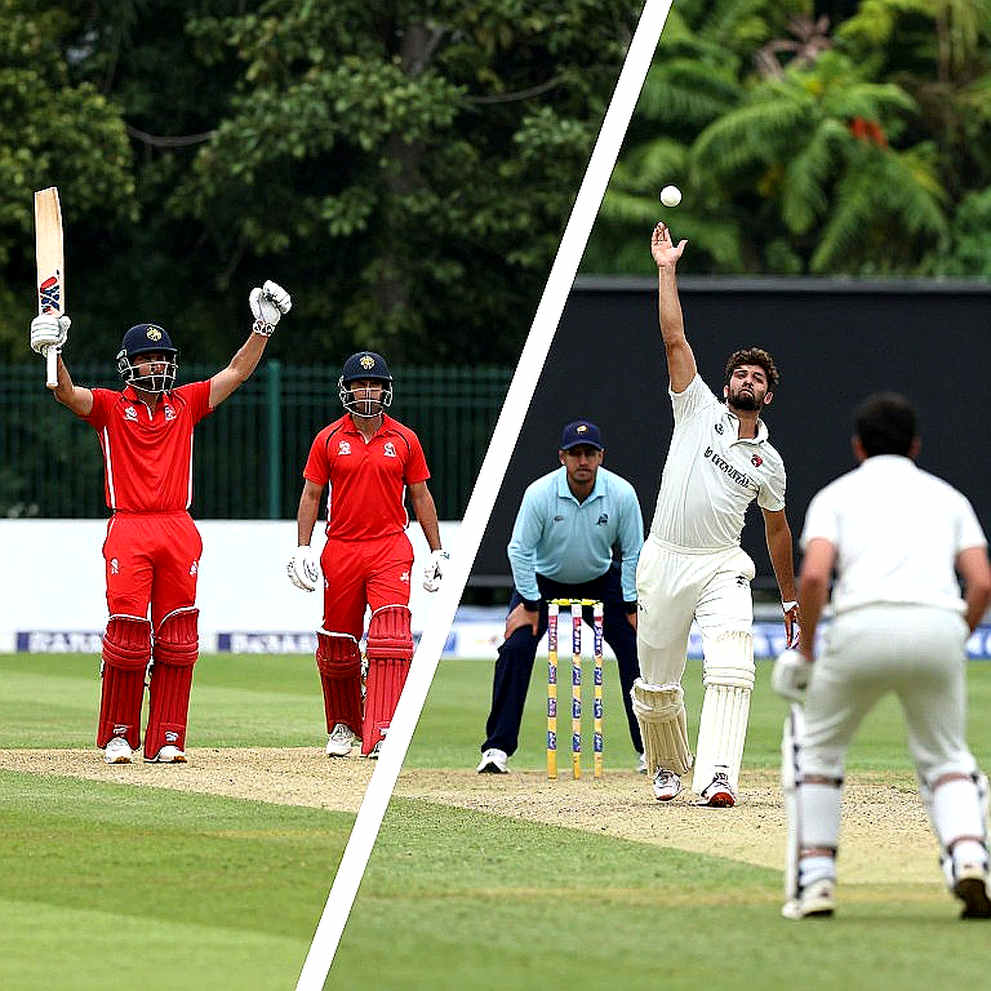
And above all of it sits Sam Konstas: 71 in the first innings, 151 not out in the second, off 167 balls, with four sixes — a strike rate near 90. It was his fifth first-class century, reached off 136 balls. In first-class cricket an opener around 50-60 is the norm; 90 is a decision to compress the bowler, not a default tempo. The two-innings pair matters more than the headline number, because it steps outside the small-sample trap that catches most young batters.
The detail that usually gets a single line deserves more: the innings was described as mostly orthodox, the best shot a straight hit. That matters, because the standard anxiety about a young batter striking at 90 is that the runs are coming from risk. Here they were not. And when Jhye Richardson twice removed Ollie Davies with the same bouncer plan — Davies had made 52 off 58 that first morning, after 253 off 225 against Tasmania — Konstas answered that plan by swatting a short ball over deep square leg. What was a trap for one batter was a scoring option for the other.
I keep a ledger across the seasons — every declaration's timing, every new-ball over, every substitution. One conclusion repeats: the spreadsheet was right about everything except the part that mattered. Dwarshuis's 2-5 and Edwards's 1-0 look commanding in a column, but they are five deliveries. They record when the wickets came, not how the bowling dominated. Konstas's 90 strike rate is the same kind of number, and the open question is whether that is his sustainable tempo or the effect of an audience — national selector Tony Dodemaide was in the ground and reportedly grinning from ear to ear at the straight hit.
This is where the match and the selection decision stop being separate things. Australia's Test batting was struggling in South Africa at the same time, and a hundred in Perth is being presented as the answer to that struggle. The one dataset nobody has produced is the split that actually matters: home versus away, and his record against genuine pace. I spent a week in the appendices so you wouldn't have to — WACA on a docile deck is not the examination. A moving ball at 140 is.
The real story for the home side is not Konstas; it is Hardie. A shoulder and a knee are both on the active list. He began the season as a specialist batter and missed Australia A's tour of India. For an all-rounder with 15 ODIs and 18 T20Is behind him, a shoulder is heavier than a specialist batter's shoulder, because it touches the bowling action and the throw. The arithmetic is plain: the 12-day floor becomes two fixtures, and if the scan is unkind, a large slice of the season.
In the same match the captaincy passed through three pairs of hands — Hardie, then Cartwright, then Paris and Shaw. Cartwright's finger was split in the field and he is expected to be available to bat on day four. Three captains, one match, one uncapped replacement: not intrigue, just a thin bench showing its edge. Corey Rocchiccioli's 3 for 90 is expensive on a docile surface, but on day four the same spinner may be the decisive threat.
Here is where sentiment and the rules take different exits. The ground report says the surface is docile, which means day four should be the best batting day of the match. If that holds, a side needing 334 with three wickets down is not finished. Three documents — the scorecard, the declaration time, and the medical sheet — are telling three different stories. The scorecard shows a home defeat, the declaration shows a management win, and the medical sheet says the actual damage will be visible over the next fortnight. Anyone treating Konstas as an immediate solution is reading a selector's smile as evidence. Smiles are not evidence.
Day four's first session decides whose story this becomes. If the hosts survive it, the declaration will be questioned and the match reopens. If they fold before lunch, it will be filed as a declaration masterclass — when the honest account will say the result was shaped by one batter's shoulder and one captain's finger. Konstas's real examination begins next month, against pace rather than a soft Perth deck. For now one question sits unanswered: a Test problem in South Africa is being solved with a Shield hundred in Perth, and the paperwork behind that treatment has not been published. — Root: Referee